
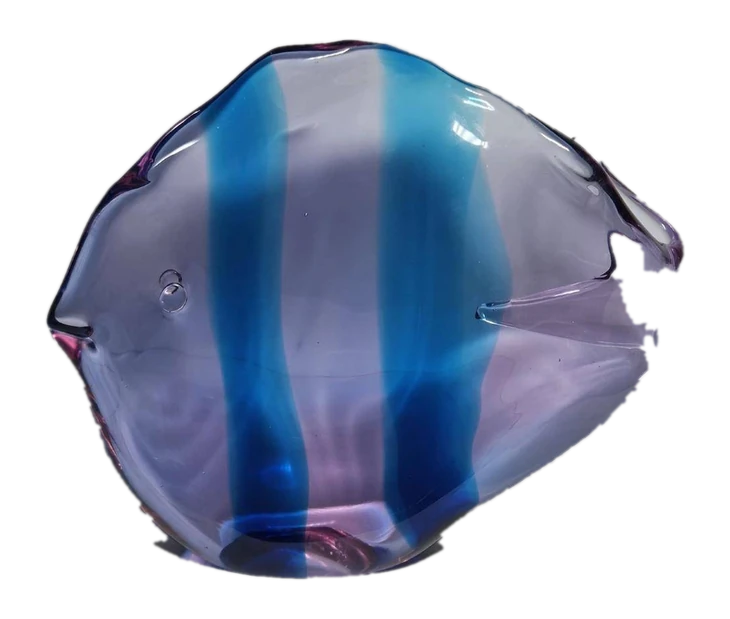
Glass from an island
Murano is a small island in the Venetian lagoon. In 1291 Venice moved its glass furnaces there, partly to keep the fire risk away from the city. The island has been synonymous with fine glass ever since, and the mid-20th century pieces are what most vintage collectors go after.
Techniques to know
Sommerso means "submerged": layers of color cased one inside another. Millefiori uses slices of patterned glass cane that look like tiny flowers. Latticino weaves white threads through clear glass, bullicante traps rows of controlled bubbles, and aventurine adds glittering copper flecks.
Is Murano glass marked?
Often not. Many vintage pieces left Murano with only a foil or paper label, and those get lost. Some carry an etched signature from the studio or artist. Since 1994 the Veneto region has backed a "Vetro Artistico Murano" trademark label, but that only applies to newer certified pieces, so vintage glass won't have it.
Murano or "Murano style"?
Lots of glass sold as Murano was made somewhere else in the same style, including plenty of modern imports. Original labels, signatures, weight and the quality of the work all help, but without a label or signature an honest seller will usually call it Murano-style. That's what we do: we tell you what we know about a piece and what we don't.
Is Murano glass valuable?
Signed pieces, known studios and designers, and complex technique bring the most. A lot of unsigned souvenir glass is affordable and still gorgeous on a windowsill. Check for chips, scratches and cloudiness, and hand wash it rather than using the dishwasher.
Murano Glass FAQ
How do I know if Murano glass is real?
Look for an original label naming a Murano furnace, a signature you can trace to a real studio or artist, or, on newer pieces, the Vetro Artistico Murano trademark label. Without those, we call a piece Murano-style and explain why.
Is Murano glass always signed?
No. Plenty of genuine vintage Murano was sold with only a paper or foil label that has since come off. A signature helps, but its absence doesn't rule a piece out.
Does "Made in Italy" mean Murano?
Not necessarily. Italy has other glassmaking towns, such as Empoli in Tuscany. A label needs to say Murano, or name a Murano furnace, to point to Murano.
What is sommerso glass?
Sommerso ('submerged') is a Murano technique where layers of different colored glass are cased one inside another, creating bold bands of color.
Is Murano glass dishwasher safe?
We don't recommend it. Hand wash vintage art glass gently in lukewarm water to avoid scratches, clouding and temperature shock.